Saturday, April 09, 2005
Thursday, April 07, 2005
One of my favorite passages from one of my favorite books, Walker Percy's The Moviegoer (it may help you to know that "merde" is french for "shit"):
Today is my thirtieth birthday and I sit on the ocean wave in the schoolyard and wait for Kate and think of nothing. Now in the thirty-first year of my dark pilgrimage on this earth and knowing less that I ever knew before, having learned only to recognize merde when I see it, having inherited no more from my father than a good nose for merde, for every species of shit that flies--my only talent--smelling merde from every quarter, living in the very century of merde, the great shithouse of scientific humanism where needs are satisfied, everyone becomes an anyone, a warm and creative person, and prospers like a dung beetle, and one hundred percent of people are humanists and ninety-eight percent believe in God, and men are dead, dead, dead; and the malaise has settled like a fall-out and what people really fear is not that the bomb will fall but that the bomb will not fall--on this my thirtieth birthday, I know nothing and there is nothing to do but fall prey to desire.It's funny to read that again, and to leaf through my old copy, and see how much of that book in permanently imprinted in my memory. I wish I could re-attain that level of impressionability again, when every book changed my life just a little bit. Something's been lost in the meantime, it seems like nothing can touch me anymore. Is this maturity? If so, what good is it?
Thursday, March 31, 2005
Sunday, March 27, 2005
One can open Pascal's Pensees almost at random and find something wonderful. Here's a few that are particulary important for things I have been thinking about:
Between us and heaven or hell there is only life half-way, the most fragile thing in the world.And:
Neither an abasement which makes us incapable of good nor a holiness free from evil.Perhaps cynics like me would do well to remember the first part of that sentence, but we would all benefit from remembering the second part. Religion in my mind is an invitation to humility, not self-righteousness.
Saturday, March 19, 2005
Wednesday, March 16, 2005
A note on page 8 of the Cambridge edition of The Gay Science:
Plutarch reports that in a temple in the Egyptian city of Sais, there was a veiled statue of the goddess Isis with the inscription: "I am everything that is, that was, and that will be, and no mortal has ever rasied my veil." In his Critique of Judgement Kant says that this inscription is the "perhaps most sublime thing ever said."To say the sublime is to attempt to say the unsayable, or, more properly perhaps, to indicate that the unsayable is unsayable. Wittgenstein:
What we cannot speak about we must pass over in silence.
Tuesday, March 15, 2005
Monday, March 14, 2005
Nietzsche in The Gay Science:
You have no idea what you are experiencing; you run through life as if you were drunk and once in a while fall down a staircase. But thanks to your drunkenness, you don't break your limbs in the process; your muscles are too slack and your head too dull for you to find the stones of these stairs as hard as the rest of us do! For us, life is a greater danger: we are made of glass - woe unto us if we bump against something! And everything is lost if we fall!What pleases me most about this aphorism is the comic image of life as falling down stairs.
Friday, March 11, 2005
6ixtynin9

I much prefer the title as it appears in subtitled version I saw: A Funny Story about 6 and 9. This is sort of a Hitchcockian Thai film from the same director as Last Life in the Universe. It's interesting to note some similarities (dead bodies, bizarre conversations) but it's also a very different film, a dry witted observation of mounting panic rather than modern loneliness. Our heroine's problem isn't loneliness but the fact that no one will leave her alone. Her apartment because a sort of death trap for the hapless criminals and cops who come into her life, and (almost) none of it is her fault. I think there is something being said about the economic collapse of Asia in the late 90s but I'll be damned if I can figure out what it is. Still, it's a fun film and I can even say my mother wholeheartedly endorses it despite the very dark humor. The most charming aspect of the film are some very strange dialogues that do a nice job of pointing the absurd things people say all the time without hitting us over the head with comedic beats and dead-pan looks. It just shows people engaging in the kind of casual exaggeration that makes conversation interesting. When informed by her hostage taker that his mother died of an infection in her fingernails somehow picked up in a nail salon, the heroine pauses for a moment of sympathy but then, with only the slightest look of concern on her face immediately asks "which nail salon?" The funny and violent plot holds many such little pleasures.
I much prefer the title as it appears in subtitled version I saw: A Funny Story about 6 and 9. This is sort of a Hitchcockian Thai film from the same director as Last Life in the Universe. It's interesting to note some similarities (dead bodies, bizarre conversations) but it's also a very different film, a dry witted observation of mounting panic rather than modern loneliness. Our heroine's problem isn't loneliness but the fact that no one will leave her alone. Her apartment because a sort of death trap for the hapless criminals and cops who come into her life, and (almost) none of it is her fault. I think there is something being said about the economic collapse of Asia in the late 90s but I'll be damned if I can figure out what it is. Still, it's a fun film and I can even say my mother wholeheartedly endorses it despite the very dark humor. The most charming aspect of the film are some very strange dialogues that do a nice job of pointing the absurd things people say all the time without hitting us over the head with comedic beats and dead-pan looks. It just shows people engaging in the kind of casual exaggeration that makes conversation interesting. When informed by her hostage taker that his mother died of an infection in her fingernails somehow picked up in a nail salon, the heroine pauses for a moment of sympathy but then, with only the slightest look of concern on her face immediately asks "which nail salon?" The funny and violent plot holds many such little pleasures.
Thursday, March 10, 2005
Monday, March 07, 2005
My Year in Movies 2004
Alternate title: Ryan's year of Asian film. Not really, since it's been clear for quite some time now that the best movies in the world are coming out of Asia, and not just Japan and Hong Kong. Add Korea, Thailand, and Taiwan as big art-house players. This list gets increasingly arbitrary towards the end, but then 10 is a fairly arbitrary number for ranking films. Just consider the top 5 my "favorites" and the rest as really strong films that I enjoyed a lot. I recognize that lists like these are pretty pointless, but it helps me keep my sanity after the Oscars and mostly idiotic mainstream critics have their say.
1. House of Flying Daggers

I'll try to do my best here to avoid superlatives. I'll also try to avoid ranting about critics and viewers unable to see past the spectacle (or, even worse, those who call it merely spectacle) to the rather complex subtleties of the film. On the other hand, it's a melodrama, and if you're too hip for that well I'm sorry for you. Let's just focus on the stunning visual rhymes which also have thematic weight. Consider for instance what seems like the rather pointless shot of falling leaves, which then becomes connected to an image of soldiers falling from the tops of trees, and then recognize this is visual demonstration of how the government views these disposable men, and exactly the fate that each protagonist is trying to escape. The numerous reversals of the plot are not merely "gotcha" storytelling but also investigations into the difficulty of being able to tell when someone is being genuine or not. People pretending to be in love will fall in love, and is their allegiance to the game or something else, something higher, more authoritative perhaps? The final scene in particular hinges on a moment of extreme mendacity, and almost superfluous cruelty, that extends but does not solve the problem of shifting appearances. The perpetrator, the third wheel of this particular love triangle, is a representative of the conflicting systems of power in control of both protagonists, and so shows that his power (and so the system's) is based on mere appearance. His final act proves that he is just playing a game with their lives. The problem is that in this film the games go all the way up and all the way down, and their attempt to escape these systems (of death, really) cannot but fail at a moment of yet another false appearance.
2. Spring, Summer, Fall, Winter...and Spring

I have already written about this one here. I mostly agree with what I wrote there. The scene of extreme spiritual striving at the end of the film is still one of the most moving passages I have ever seen in a film, and while the rest of the film is very good, it's merely leading up to that moment.
3. Last Life in the Universe
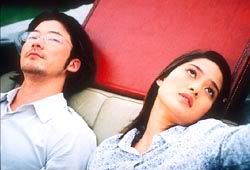
A thoroughly bizarre film. Your standard modern ennui with your not standard at all Yakuza sub-plot (which basically disrupts all your previously held notions about the main character by the end of the film). I loved about this movie though, which literally had me smiling throughout most of it, despite how sad (and my god the ending is sad!) it is. English is apparently the lingua franca of the Asian world, and so this movie about a Japanese man in Thailand is mostly in English. This little conceit though works wonders for the movie. Since the characters can only talk in very simple sentences, and since communication is so hard, it serves to highlight the desire to simply talk to someone that drives so much of the film (the title reflects the protagonist's feelings of loneliness). Often language tapes are playing in the background and we are forced to listen to inane small talk in Japanese. Or someone begins to list all the words they know in Thai like "thank you" and "good luck." It's these little gestures of connection that make the film so powerful and so moving that I can forgive the cruel ending. Now, does any of that mean I have any idea why the Yakuzas show up, who our protagonist really is, and why, oh why, is the lead girl played by two different actresses? No, of course not.
4. Hero
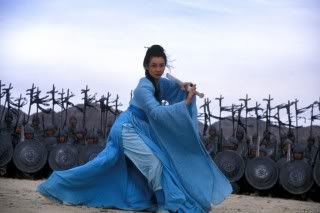
Yet another great film from Zhang Yimou (see #1). This one was originally a much lesser film for me, but after a second viewing I turned around. The political meaning is debatable, and I go back and forth myself. But nevertheless, I love that the film depicts the fundamentally contradictory desires of doing the best for All and doing the best for Some. All of this leads us to make complex (and, crucially, morally culpable) decisions. It's probably the discomfort of being ethically challenged in this way that caused much of the political criticism of this movie. God forbid someone suggest we can't have our cake and eat it too. Besides, any movie starring both Tony Leung and Maggie Cheung is automatically great.
5. Friday Night Lights
The best American film of the year. There's one image in particular that stands out for me from early on: a football stadium brilliantly lit up surrounded by the oppressive darkness of West Texas. I don't think that poignant image is an accident since the film continually underscores that point: football is only shot at redemption and heroism these boys have. To merely look down on that desire would be disgusting, and to merely idealize it (and the inevitable suffering it causes) would be irresponsible. This movie miraculously avoids both. What we get is a tremendously empathetic portrayal of poor white Southerners, one that will perhaps go unheralded for quite some time from people for whom this way of life is too distant and alien and threatening after the Election. Racism, power, and poverty are placed before us as facts but not dwelled on. What we get is a mood piece, not investigative journalism. But this is not a grid-iron Hoosiers. That film was about achieved redemption. This movie is about failure and how one accepts it. That these boys are able to accept their ordinary non-heroic lives, or least that they have to accept that challenge, makes them heroes of a different sort. The final play of the final game would seem a bit over the top if it didn't perfectly underscore visually the thematic point it was making.
6. Eternal Sunshine of the Spotless Mind
Already overrated by lonely sadsack hipsters (hey that's me!) but it's still wonderful. Others have written on the Nietzschean parallels, so I won't bother.
7. Goodbye, Dragon Inn
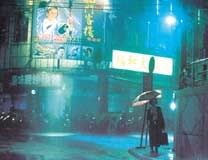
Another small masterpiece from Ming-liang Tsai, who made What Time is it There? which is one of my favorite movies ever. Very funny, very perplexing and sad too. There's almost no dialogue in this movie, and the camera hardly moves. One shot in particular shows an empty movie theater for like 2 minutes. Ah, the rigors and pleasures of art house movie going! Only for the really hardcore cineastes I guess, but it is full of rapturous melancholy about our dreams, the movies, loneliness, and the vanishing communal aspect of movie going.
8. Before Sunset
Already written on this one here. I think I overrated it at first. Still great though.
9. The Return
A fascinating parable about something. I had an elaborate theory about this movie when I saw it a few months ago but now I have forgotten it. I think it had something to do with our desire for the Father conflicting with out desire for Freedom. What sticks in my mind is the Oedipal power struggle, as well as failures of trust that prove so fatal. "I could love you if you weren't so cruel" says the younger boy to his father. Or is he talking to God?
10. Collateral
Action existentialism. Hero confronts nihilism and overcomes it. Ok, I eat that stuff up but you may be yawning. Fair enough. See it for the simply gorgeous vision of a rundown nighttime LA. A dreamscape that turns into a nightmare.
Also good:
Kill Bill, vol. 2
Anchorman
Dogville
Sideways
The Aviator
Million Dollar Baby
Harold and Kumar Go to White Castle
Alternate title: Ryan's year of Asian film. Not really, since it's been clear for quite some time now that the best movies in the world are coming out of Asia, and not just Japan and Hong Kong. Add Korea, Thailand, and Taiwan as big art-house players. This list gets increasingly arbitrary towards the end, but then 10 is a fairly arbitrary number for ranking films. Just consider the top 5 my "favorites" and the rest as really strong films that I enjoyed a lot. I recognize that lists like these are pretty pointless, but it helps me keep my sanity after the Oscars and mostly idiotic mainstream critics have their say.
1. House of Flying Daggers
I'll try to do my best here to avoid superlatives. I'll also try to avoid ranting about critics and viewers unable to see past the spectacle (or, even worse, those who call it merely spectacle) to the rather complex subtleties of the film. On the other hand, it's a melodrama, and if you're too hip for that well I'm sorry for you. Let's just focus on the stunning visual rhymes which also have thematic weight. Consider for instance what seems like the rather pointless shot of falling leaves, which then becomes connected to an image of soldiers falling from the tops of trees, and then recognize this is visual demonstration of how the government views these disposable men, and exactly the fate that each protagonist is trying to escape. The numerous reversals of the plot are not merely "gotcha" storytelling but also investigations into the difficulty of being able to tell when someone is being genuine or not. People pretending to be in love will fall in love, and is their allegiance to the game or something else, something higher, more authoritative perhaps? The final scene in particular hinges on a moment of extreme mendacity, and almost superfluous cruelty, that extends but does not solve the problem of shifting appearances. The perpetrator, the third wheel of this particular love triangle, is a representative of the conflicting systems of power in control of both protagonists, and so shows that his power (and so the system's) is based on mere appearance. His final act proves that he is just playing a game with their lives. The problem is that in this film the games go all the way up and all the way down, and their attempt to escape these systems (of death, really) cannot but fail at a moment of yet another false appearance.
2. Spring, Summer, Fall, Winter...and Spring
I have already written about this one here. I mostly agree with what I wrote there. The scene of extreme spiritual striving at the end of the film is still one of the most moving passages I have ever seen in a film, and while the rest of the film is very good, it's merely leading up to that moment.
3. Last Life in the Universe
A thoroughly bizarre film. Your standard modern ennui with your not standard at all Yakuza sub-plot (which basically disrupts all your previously held notions about the main character by the end of the film). I loved about this movie though, which literally had me smiling throughout most of it, despite how sad (and my god the ending is sad!) it is. English is apparently the lingua franca of the Asian world, and so this movie about a Japanese man in Thailand is mostly in English. This little conceit though works wonders for the movie. Since the characters can only talk in very simple sentences, and since communication is so hard, it serves to highlight the desire to simply talk to someone that drives so much of the film (the title reflects the protagonist's feelings of loneliness). Often language tapes are playing in the background and we are forced to listen to inane small talk in Japanese. Or someone begins to list all the words they know in Thai like "thank you" and "good luck." It's these little gestures of connection that make the film so powerful and so moving that I can forgive the cruel ending. Now, does any of that mean I have any idea why the Yakuzas show up, who our protagonist really is, and why, oh why, is the lead girl played by two different actresses? No, of course not.
4. Hero
Yet another great film from Zhang Yimou (see #1). This one was originally a much lesser film for me, but after a second viewing I turned around. The political meaning is debatable, and I go back and forth myself. But nevertheless, I love that the film depicts the fundamentally contradictory desires of doing the best for All and doing the best for Some. All of this leads us to make complex (and, crucially, morally culpable) decisions. It's probably the discomfort of being ethically challenged in this way that caused much of the political criticism of this movie. God forbid someone suggest we can't have our cake and eat it too. Besides, any movie starring both Tony Leung and Maggie Cheung is automatically great.
5. Friday Night Lights
The best American film of the year. There's one image in particular that stands out for me from early on: a football stadium brilliantly lit up surrounded by the oppressive darkness of West Texas. I don't think that poignant image is an accident since the film continually underscores that point: football is only shot at redemption and heroism these boys have. To merely look down on that desire would be disgusting, and to merely idealize it (and the inevitable suffering it causes) would be irresponsible. This movie miraculously avoids both. What we get is a tremendously empathetic portrayal of poor white Southerners, one that will perhaps go unheralded for quite some time from people for whom this way of life is too distant and alien and threatening after the Election. Racism, power, and poverty are placed before us as facts but not dwelled on. What we get is a mood piece, not investigative journalism. But this is not a grid-iron Hoosiers. That film was about achieved redemption. This movie is about failure and how one accepts it. That these boys are able to accept their ordinary non-heroic lives, or least that they have to accept that challenge, makes them heroes of a different sort. The final play of the final game would seem a bit over the top if it didn't perfectly underscore visually the thematic point it was making.
6. Eternal Sunshine of the Spotless Mind
Already overrated by lonely sadsack hipsters (hey that's me!) but it's still wonderful. Others have written on the Nietzschean parallels, so I won't bother.
7. Goodbye, Dragon Inn
Another small masterpiece from Ming-liang Tsai, who made What Time is it There? which is one of my favorite movies ever. Very funny, very perplexing and sad too. There's almost no dialogue in this movie, and the camera hardly moves. One shot in particular shows an empty movie theater for like 2 minutes. Ah, the rigors and pleasures of art house movie going! Only for the really hardcore cineastes I guess, but it is full of rapturous melancholy about our dreams, the movies, loneliness, and the vanishing communal aspect of movie going.
8. Before Sunset
Already written on this one here. I think I overrated it at first. Still great though.
9. The Return
A fascinating parable about something. I had an elaborate theory about this movie when I saw it a few months ago but now I have forgotten it. I think it had something to do with our desire for the Father conflicting with out desire for Freedom. What sticks in my mind is the Oedipal power struggle, as well as failures of trust that prove so fatal. "I could love you if you weren't so cruel" says the younger boy to his father. Or is he talking to God?
10. Collateral
Action existentialism. Hero confronts nihilism and overcomes it. Ok, I eat that stuff up but you may be yawning. Fair enough. See it for the simply gorgeous vision of a rundown nighttime LA. A dreamscape that turns into a nightmare.
Also good:
Kill Bill, vol. 2
Anchorman
Dogville
Sideways
The Aviator
Million Dollar Baby
Harold and Kumar Go to White Castle
Sunday, March 06, 2005
Saturday, February 26, 2005
Tuesday, February 22, 2005
This interview with Simon Critchley is worth your time. If you're busy, here's a good excerpt:
Nietzsche's response to nihilism is the doctrine of eternal return. You could read that in a cosmological way, as a belief that the universe is cyclical and is going to recur. Or, as you hinted, Vico's notion of cycles of history could be seen as signalled. I think that's all window dressing, though; I don't think that's what Nietzsche means. For him, eternal return is much more of a moral doctrine.This part is also interesting:
There's a story told by the poet Heine about Kant walking on the heath with his servant just after writing the first Critique, the Critique of Pure Reason, in which he takes God away. He looks at his servant and suddenly feels so sorry for him because he's taken God away from him that he writes a second Critique, just to give God back. The essential thesis of the Critique of Pure Reason is that traditional metaphysics, God, freedom and immortality, is cognitively meaningless. We cannot know whether God exists, whether the soul is immortal and so on. That's the First Critique. Then in the Second Kant says: But we can still maintain the idea of God, or immortality of the soul as a postulate, a postulate of practical reason. So although I cannot know whether God exists, I can still act as if he did, and that can orientate my ethical activity.
Nietzsche ups the ante and takes it a stage further. He says: Well, this is ridiculous. What would it be to fully affirm the fact that God doesn't exist? To fully affirm the complete meaninglessness of the universe? And to be able to do that again and again and again. If you're capable of that thought, of affirming that this universe is not for us, that we're just here by sheer chance, and you can do that again and again, then you're equal to the force of eternal return. It's a sort of moral test.
If I could go back to what I was saying about Nietzsche: what people get excited about in his work is this notion of affirmation: an affirmation in relation to death. I can affirm the meaninglessness of the universe and the ultimate meaninglessness of my own life, and heroically assume that. There's something almost disgusting about that thought after the holocaust, it seems to me. Adorno puts his finger on this quite well in the final part of Negative Dialectic. He's concerned with after Auschwitz. He says that a new categorical imperative has imposed itself on humankind: not to let Auschwitz repeat itself, and not to hand Hitler posthumous victories. He goes on to say that the situation of the death camps is best described not by descriptions of them, but by, for example, the work of Beckett. Why? Because it doesn't say anything about them; it doesn't attempt to represent what took place.Now here is another interview with Critchley on humor, from a later date i think.
I begin from the assumption that modernity is defined by the impossibility of any metaphysical belief in a deity. That's where I begin from and that is axiomatic for me. It means that if I had a religious experience I would stop doing philosophy: philosophy for me is essentially atheistic.Now, it's important to keep the metaphysical "death of God" separate the question of whether God exists or not, but even so I found this to be a pretty interesting statement because I've always thought religious experiences to be a key motivator of philosophy in the first place. Wouldn't the felt presence of God necessarily act just like the nothingness of existentialism, or the anxiety of Heidegger. God, whether he exists or not, seems to represent a radical Otherness from this world that threatens and calls it into question.
Sunday, February 13, 2005
Michael Tanner on Nietzsche's last year of sanity and Twilight of the Idols:
And this is Nietzsche bravely talking about the joys of heaven from a position in hell--for this last year he says No as never before. One might even say that his affirmations are only, and this is his tragedy, the negations of negations. His faith--and it is remarkable to find him talking of faith at all in a positive way--is that it is possible to be someone who does not need to negate first. But he could never be that person, and the more dialectical cartwheels he turns, with wonderful and entrancing dexterity, the further he is removed from that ideal. The only Dionysus we can identify him with is the one torn into innumerable agonized fragments.I think this passage does a pretty good job summing up my own misgivings about Nietzsche, while still maintaining the respectful awe I feel towards the writings he left us. And if we accept Tanner's idea that Nietzsche wanted to be someone who didn't need to negate in the first place then we have to think that perhaps Nietzsche's philosophy becomes a relentless and agonizing self-criticism (of the pessimist inside, perhaps) that simply enacts, over and over (the tragic irony!), the problem it seeks to solve. If only philosophy had the power to do away with itself...if only it would perish forever in an instant of joy, of pure Yes-saying, that abolishes all the little no's we say in self-defense against the universe.
Friday, February 04, 2005
Wednesday, February 02, 2005
The Metaphysics of Donald Rumsfeld.
The Unknown
As we know,
There are known knowns.
There are things we know we know.
We also know
There are known unknowns.
That is to say
We know there are some things
We do not know.
But there are also unknown unknowns,
The ones we don't know
We don't know.
This is a very old article, but I thought it would be fun to link to it again. The "poem" above is really quite brilliant, and even metaphysically profound!
There is another fantastic (and profound) saying of his not listed. To paraphrase from memory (actually the memory of a friend): "You are starting wiyh an illogical assumption and proceeding logically to an illogical conclusion." Saying this will win you every argument ever!
The Unknown
As we know,
There are known knowns.
There are things we know we know.
We also know
There are known unknowns.
That is to say
We know there are some things
We do not know.
But there are also unknown unknowns,
The ones we don't know
We don't know.
This is a very old article, but I thought it would be fun to link to it again. The "poem" above is really quite brilliant, and even metaphysically profound!
There is another fantastic (and profound) saying of his not listed. To paraphrase from memory (actually the memory of a friend): "You are starting wiyh an illogical assumption and proceeding logically to an illogical conclusion." Saying this will win you every argument ever!
Tuesday, February 01, 2005
Yet more proof that we live in the best of all possible worlds. (Brace yourself. I'm not kidding.)
See more of God's aborted creations here.

See more of God's aborted creations here.
Conor Cunningham on Plotinus and the non-being of the One in Genealogy of Nihilism:
The One cannot be alone. The One cannot be alone because that which proceeds from its plenitude does no necessarily. Furthermore, the One many well require that which emanantes so that it can itself be the One....If there were no emanations there would be the nihilism of pure undifferentiated "being" which may threaten the possibility of the One. As Plotinus says, "something besides unity (the One) there must be or all would be indiscernibly buried, shapeless within that unbroken whole." If there was only the One it might be unable to be the One, for we know for certain it must produce. But if the One requires company, that which accompanies it must be nothing because of this necessity, if simplicity is to be protected. In being nothing the One and the many are equivalent; this many is but the one that comes from the One. In this way the one that is produced is nothing. The One needs this one which is nothing. But in needing nothing it needs nothing but itself (for the One is non-being).Fascinating stuff! Interesting to compare this mirrored nihilism with Schopenhauer, where will and representation essentially dissolve into nothing at the conclusion of The World as Will and Representation (the implied unity of the title would seem to necessitate this). I don't know much about Cunningham, or "Radical Orthodoxy" for that matter, but just a few pages in this book seems pretty remarkable. Also interesting to compare it with systems theory: the necessary distinction between system and environment which requires excluding the nothing (environment) in the service of coherence (system), but nevertheless requires including it because the distinction is itself the founding self-reference that makes meaning. (Yeah, it's difficult stuff!)
Subscribe to:
Posts (Atom)